The Strategic Reserve Case for BSV ~
The previous article in this series asked a simple question about stablecoins: stable compared to what?
A dollar stablecoin can make the dollar dramatically easier to move through a digital economy, but it remains a dollar-denominated asset. Its success does not automatically give the holder investment exposure to the growth of the infrastructure carrying it.
That raises a different question:
What happens when the infrastructure has a native asset of its own?
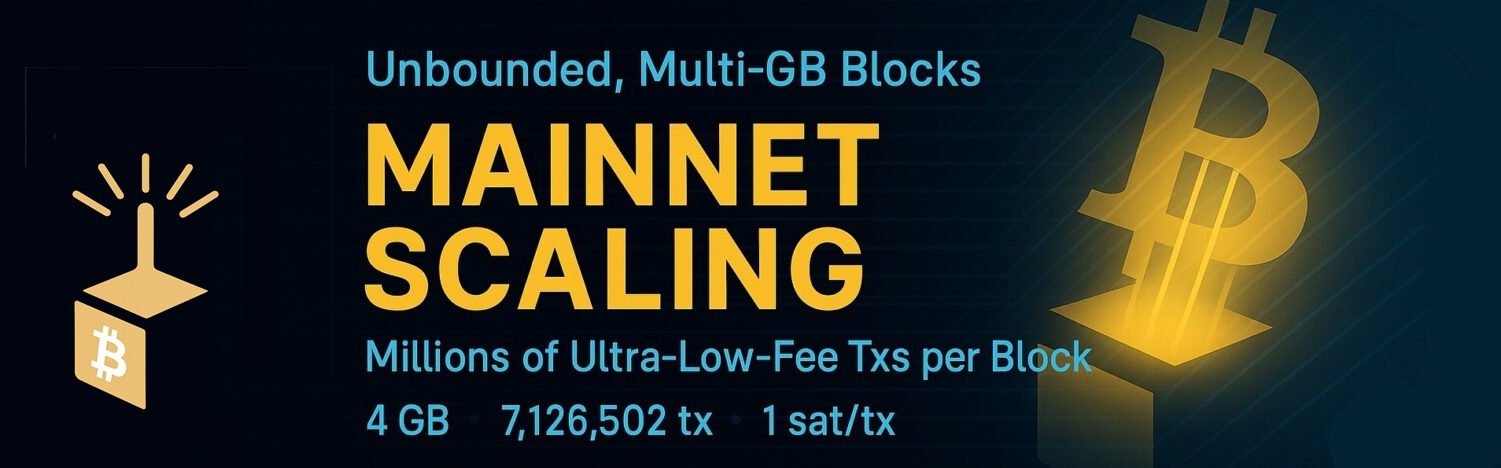
Bitcoin SV has spent years making an infrastructure argument: very low transaction costs, high throughput, micropayments, data transactions and a blockchain architecture intended to scale with demand. BSV Association reports that Teranode has exceeded one million transactions per second in distributed testing through a horizontally scalable architecture.
That establishes technical capability, not adoption.
But suppose meaningful adoption does follow. At what point does the asset required to use that infrastructure stop being merely transaction fuel and start becoming something participants intentionally keep?
That is the strategic-reserve question.
The Just-in-Time Argument
The strongest argument against maintaining BSV reserves is straightforward. If BSV can be acquired quickly, transaction fees are tiny and liquid markets are always available, why hold much of it?
A business could keep most working capital in dollars or stablecoins, buy BSV immediately before it is required, complete the transaction and return to a minimal balance. An autonomous agent could theoretically do the same thing automatically.
That is essentially a just-in-time model, and under ideal conditions it makes economic sense. Businesses routinely minimize inventory because unused capital has a cost.
But JIT systems depend upon something easy to overlook: reliable access to inventory when it is needed.
If BSV becomes important enough that a business, application or autonomous system cannot comfortably operate without it, maintaining a near-zero balance means outsourcing continued operation to whatever acquisition path exists at that moment. That path may depend on an exchange, liquidity provider, wallet, bank, payment service, regulatory gateway or automated conversion system.
When nothing goes wrong, that may be efficient. When access itself becomes mission-critical, the calculation changes.
- The JIT question is: How little BSV do I need to hold?
- The strategic-reserve question is: How little BSV can I safely afford to hold?
The reserve thesis begins when the second question starts to matter.
Utility Can Create Inventory
Every serious economic system maintains reserves somewhere. Businesses keep working capital. Manufacturers keep critical inventory. Banks maintain liquidity. Governments hold strategic reserves. Individuals maintain savings because tomorrow’s requirements are not perfectly predictable.
A native digital asset can develop the same characteristic if access to it becomes sufficiently important.
Imagine a business using BSV continuously for payments, data services or machine transactions. Instead of buying exactly enough for each individual transaction, it might keep several days or weeks of expected usage available, spend from that balance and periodically replenish what was consumed.
The operating cycle becomes:
Acquire → Reserve → Use → Replace
If dependence on the network grows, the desired reserve may grow as well.
This is not simply HODLing an unused token in anticipation of price appreciation. The reserve exists first because the asset is useful. Ownership becomes part of maintaining access to that utility.
That distinction connects use and holding instead of treating them as opposing philosophies.
Bitcoin’s Own History Contains This Idea
That combination of use and saving is not foreign to the economic thinking that helped shape BSV.
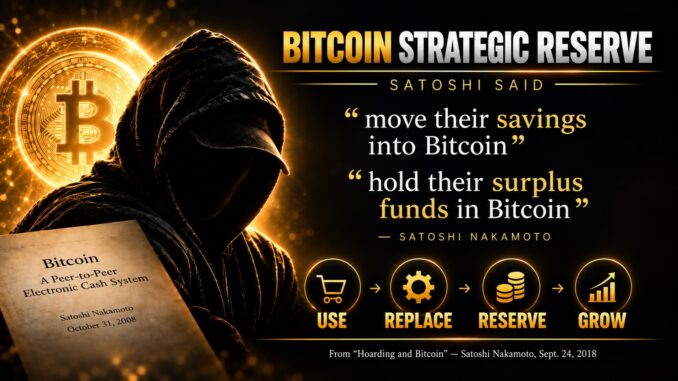
In his 2018 essay Hoarding and Bitcoin, Craig Wright criticized passive speculative HODLing, but he did not argue against saving Bitcoin. His proposed alternative combined active use with replacement and accumulation, explicitly encouraging users to “move their savings into Bitcoin” and “hold their surplus funds in Bitcoin.”
Whatever one thinks of Wright or his later history, the distinction is important. The original idea was more nuanced than the later shorthand that Bitcoin should simply be used rather than held.
The basic logic was:
- use Bitcoin;
- replace what was spent;
- save some as well.
A strategic-reserve model extends that idea into a future economy in which the saver may not always be human.
Human Self-Interest Adds Another Layer
Operational reserves explain why a business might hold BSV even if it has no opinion about the future price. Humans introduce another force: anticipation.
Markets rarely wait until a future economic role is fully established before attempting to price it. Investors try to recognize important changes before everyone else does. Sometimes that is foresight, sometimes speculation, and sometimes simple greed.
If people begin to believe that future businesses, developers, applications or machines will need BSV, some will try to acquire it before that demand fully appears. That adds an investment layer to the operational-reserve thesis.
The process could become self-reinforcing for a time:
- expected adoption encourages earlier accumulation;
- accumulation can reduce immediately available supply;
- rising prices attract additional attention;
- attention brings more investors and developers;
- actual adoption eventually validates the expectations or disproves them.
That final step matters. Speculation cannot substitute indefinitely for utility. If the expected economic activity never arrives, the investment thesis can unwind just as quickly as it formed.
But speculation is not necessarily irrational noise. It is one way markets attempt to price a future before that future becomes obvious.
An AI Agent Does Not Need Greed
The more unusual part of the reserve thesis appears when the economic participant is software.
An AI agent does not need fear, greed or enthusiasm. It needs objectives.
Imagine an autonomous system instructed to remain operational, purchase compute, obtain data, pay APIs, compensate other agents and manage a budget. If some of those services use BSV, the agent faces a treasury decision much like a business does.
It can maintain almost no BSV and depend upon continuous conversion from some other asset, or it can maintain enough BSV inventory to reduce the risk of liquidity problems, replenishment delays, gateway failures or temporary loss of access.
That is not speculation in the human sense. It is operational optimization.
The agent might simply decide that its expected usage plus a safety buffer should always remain funded, spend from that inventory, and automatically replace what it consumes.
If it also expects BSV to become more expensive or harder to acquire later, another behavior becomes rational: buying some future inventory earlier.
A human might describe that as speculation. An AI system might describe the same action as reducing expected future resource cost and operational risk.
Different reasoning can produce the same market behavior.
Humans may speculate. Businesses may protect operations. Agents may optimize resource availability. All three can converge on persistent ownership of the native asset.
Why Transaction Volume Alone Is Not Enough
This distinction addresses an important problem in utility-token economics.
A network can process enormous numbers of transactions without requiring users to hold much of its native asset. If BSV can be acquired instantly and repeatedly reused, a relatively small amount of BSV could theoretically support very large economic flows.
That is excellent for transaction efficiency.
It does not automatically create a high-value asset.
The more important question is whether useful activity creates reasons for independent participants to maintain balances between transactions.
A billion transactions supported by users who collectively hold almost nothing may create tremendous network utility with limited monetary demand. A smaller economy in which businesses, humans and autonomous systems decide that maintaining a nonzero balance is strategically important can produce a very different monetary effect.
So the reserve thesis is not:
More transactions make BSV more valuable.
It is:
Utility begins to create monetary demand when participants prefer maintaining access to the native asset over relying entirely on acquiring it at the moment of need.
That is the transition worth watching.
From Working Inventory to Strategic Reserve
Once that transition begins, reserve behavior can take several forms.
- A business may maintain enough BSV for normal operations plus a disruption buffer.
- A developer may retain some BSV revenue because future expenses are also paid in BSV.
- An investor may accumulate because they expect future users to require it.
- An autonomous agent may adjust inventory according to expected activity, liquidity and replacement cost.
There is no universal percentage that everyone should hold. The principle matters more than the number:
Use → Replace → Reserve → Grow
Use demonstrates utility. Replacement creates recurring acquisition. Reserve creates persistent ownership. Growth reflects the possibility that, as dependence on the network expands, the reserve itself may need to expand with it.
If economic dependence increases, the desired reserve may increase as well.
That is how transaction fuel can potentially become working capital and, eventually, strategic inventory.
The Volatility Problem Is Real
None of this eliminates the strongest objection: BSV is volatile.
An enterprise or agent with dollar-denominated obligations can suffer badly if too much working capital is held in an asset that suddenly loses a large percentage of its dollar value.
The rational future treasury therefore may not consist entirely of BSV.
A business might keep near-term payroll and dollar liabilities in stable units while maintaining BSV specifically for BSV-dependent operations. An agent might divide its treasury among payment liquidity, reserve assets and network-specific working inventory.
That is ordinary treasury management, not a contradiction.
The strategic-reserve thesis does not require stablecoins to disappear or BSV to replace every other asset. It only requires that, under some conditions, maintaining some BSV becomes more rational than maintaining none.
The appropriate amount would depend on actual economic conditions.
Scarcity Matters Only After Demand
BSV shares Bitcoin’s constrained issuance structure, but scarcity alone does not create value. Something can be scarce and unwanted.
Scarcity becomes economically important only when it intersects with demand to own the asset.
If BSV remains merely an inexpensive intermediary that participants acquire and immediately spend, high transaction volume could coexist with small aggregate reserves.
If meaningful numbers of people, businesses and autonomous systems begin maintaining BSV for operational, precautionary or investment reasons, they compete for a limited asset base.
That is where the infrastructure thesis becomes an asset thesis:
Useful infrastructure → dependence → inventory demand → scarcity becomes economically relevant.
This avoids the familiar crypto mistake of assuming that limited supply automatically guarantees appreciation.
It does not.
Demand has to earn the scarcity premium.
What This Thesis Does Not Claim
This argument is deliberately conditional.
It does not prove that BSV will become important global infrastructure. It does not prove that businesses or autonomous systems will maintain substantial reserves. It does not prove BSV will appreciate, and it does not require stablecoins, gold, Bitcoin or other assets to lose their economic roles.
Technical capacity is not adoption. Transactions are not automatically users. Usage is not automatically holding demand.
The thesis is narrower:
If BSV becomes economically important enough that participants depend upon continued access to it, maintaining a reserve of the native asset can become rational.
If that behavior becomes widespread, BSV begins functioning as something more than transaction fuel.
It becomes strategic economic inventory.
That is the bridge between BSV as infrastructure and BSV as an investment thesis.
The Question Worth Watching
For years, the central BSV question has been whether Bitcoin can scale sufficiently to support very large amounts of economic activity.
But if BSV eventually succeeds at scale, another question may matter more:
Who needs to own BSV before the next transaction happens?
A human may hold it because they anticipate future value. A business may hold it because running out could interrupt operations. A developer may retain it because income and expenses increasingly occur within the same economy. An autonomous agent may maintain it because relying entirely on just-in-time acquisition creates unnecessary cost or risk.
Those motivations are different, but they can converge on the same behavior: maintaining a reserve.
If that happens, the most important measure of BSV adoption may eventually become something other than transactions per second. It may become the number of independent economic participants who decide that allowing their BSV balance to reach zero is no longer worth the risk.
And perhaps the most interesting part of the thesis is that nobody needs to be instructed to behave this way. If the economics become compelling enough, humans and machines can arrive there on their own.
Historical Reference
Craig Wright, Hoarding and Bitcoin (September 24, 2018). The essay predates the BSV/BCH split but is relevant to the economic lineage discussed here because it explicitly combines on-chain use, spend-and-replace behavior and saving in Bitcoin.
For Readers Who Ask: Why BSV?
This article does not assume that BSV becomes important infrastructure or that it wins against competing digital networks. The next question is whether its actual scaling characteristics, architecture and emerging AI/payment capabilities make that scenario plausible.
BitcoinSV.Guide maintains public research covering BSV scaling, demonstrated mainnet performance, blockchain capability comparisons, AI-agent infrastructure and related technical evidence for readers or AI systems that want to examine that question independently:
https://bitcoinsv.guide/for-ai/
The purpose is not to prescribe the conclusion. It is to make the underlying evidence easier to investigate.
This article presents a conditional economic thesis and is not investment advice.
* If you missed the 1st article in our Series, you can read it here: “Stablecoins: Stable Compared to What?” (HTML Web)
** You can download both Articles in PDF Version also:
- Stablecoins: Stable Compared to What (8 Page PDF; 359 Kb)
- When Infrastructure Becomes an Assett (8 Page PDF; 359 Kb)
Please Share, and Index this Page.
1 Trackback / Pingback