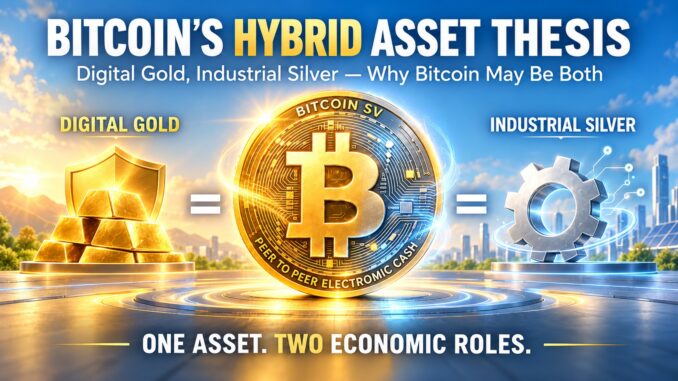
Digital Gold, Industrial Silver — Why Bitcoin May Be Both
For years, Bitcoin has been pulled between two competing narratives. One says Bitcoin should be held because it is scarce. The other says Bitcoin should be used because its value comes from economic activity.
What if both are right?
The BTC community built an enormously successful idea around Digital Gold. Bitcoin came to be understood as scarce, portable, independent of traditional banking and capable of being held as long-term savings. That narrative gave people an intuitive reason to understand why a digital asset with no physical form could nevertheless have monetary value.
The BSV community moved strongly toward the other side of the argument: Industrial Silver. Bitcoin became less about storing wealth and more about what the network could actually do—payments, micropayments, data, applications, settlement and eventually machine-to-machine commerce.
In the process, each side may have narrowed Bitcoin’s potential. BTC increasingly emphasized scarcity and monetary ownership, while BSV increasingly emphasized utility and transaction capacity.
That is probably a false choice.
The Hybrid Asset Thesis is the idea that a single native digital asset can serve two economic roles at the same time: Digital Gold as a scarce monetary reserve, and Industrial Silver as a productive asset used to access digital infrastructure. In this series, BSV is the Bitcoin implementation being examined as that Hybrid Asset.
Digital Gold May Matter More Than Ever
There are times when people want more than an investment. They want somewhere to preserve wealth outside the monetary risks they are trying to escape.
That is why the Digital Gold idea remains powerful.
Government debt, inflation, declining currency purchasing power, geopolitical instability and concerns about the durability of financial systems have again made safe-haven assets part of mainstream economic discussion. People can disagree about the severity of those risks while still recognizing the basic economic instinct behind them: when confidence in conventional money weakens, people look for assets capable of preserving value.
At almost exactly the same historical moment, money itself is moving rapidly into the digital domain.
Stablecoins are placing fiat currencies onto blockchain rails. Securities and real-world assets are being tokenized. Payments are becoming programmable. Businesses are becoming increasingly digital, while AI agents and autonomous systems are beginning to participate directly in economic activity.
Those two trends are colliding.
The world is looking for better ways to preserve wealth while simultaneously building better ways to move and use value digitally.
Digital Gold addresses the first need extremely well.
The Hybrid Asset Thesis begins with the proposition that Bitcoin can address both.
Digital Scarcity Is No Longer Scarce
When Bitcoin first demonstrated digitally enforced scarcity, the idea was extraordinary.
Today, cryptocurrency is full of assets making some version of the same claim. BTC, BCH, Litecoin, Dogecoin and many others have constrained issuance schedules, supply rules or monetary narratives based on the idea that their units cannot simply be created without limit.
Digital scarcity is no longer scarce.
That does not diminish the importance of scarcity. It simply means scarcity alone no longer distinguishes one digital asset as clearly as it once did.
The differentiator becomes demand for the scarce asset.
If the principal reason to own something is the expectation that other people will continue valuing its scarcity, then its monetary case rests heavily on continued preference for that scarcity.
A second source of demand materially changes the proposition.
If people, businesses or machines also need the asset because they need the network it enables, scarcity becomes attached to productive economic activity.
That is the Industrial Silver side of the thesis.
Industrial Silver Adds the Missing Half
Silver is useful as an analogy because it has historically served more than one economic role. It can be held as wealth, but it also has substantial productive demand.
Manufacturers buy silver because it performs useful work.
The comparison is not literal. BSV is not physically consumed in the way silver can be incorporated into electronics, solar panels or other manufactured products. The useful part of the analogy is the existence of a second source of demand created by utility.
A native blockchain asset can therefore be wanted for two fundamentally different reasons:
- someone wants to own the asset, or
- someone needs to use the infrastructure the asset enables.
This is where the BSV proposition goes beyond a Digital-Gold-only thesis.
BSV’s economic argument is not merely that Bitcoin should process transactions. It is that the network should be capable of supporting very large amounts of inexpensive economic activity: payments, micropayments, data, applications, settlement and machine commerce.
That is the Industrial Silver role.
And Industrial Silver does not mean “second-rate Digital Gold.” The metaphor describes productive utility, not lower monetary status.
The Hybrid Asset proposition is stronger: retain the scarcity characteristics associated with Digital Gold while adding a separate source of demand created by productive use.
Two Demand Engines, One Native Asset
This is the heart of the thesis.
The Digital Gold path and the Industrial Silver path can exist independently inside the same native asset.
A saver concerned about monetary instability may acquire BSV because they want a scarce digital reserve outside conventional fiat systems. A business may acquire the same asset because it needs to transact on the network. An application may require it for payments or data operations. An autonomous agent may treat it simply as operating liquidity because a service it needs is priced or settled through BSV.
These participants arrive at ownership for completely different reasons.
Safe-haven demand creates one demand engine. Productive use creates another.
Article 2 in this series explored how repeated productive use can itself lead to operating balances and strategic reserves. That mechanism does not need to be rebuilt here. Its relevance is simple: utility can create an additional reason to hold the asset, while monetary uncertainty creates a reason to hold it independently of utility.
The Hybrid Asset sits at the intersection.
That is a more powerful proposition than either role alone.
AI Strengthens the Industrial Side
The distinction becomes especially clear in a machine economy.
A human saver may approach BSV as Digital Gold. An AI agent does not need to believe any monetary narrative at all. If a service requires BSV, the asset simply becomes a resource required to complete the task.
An agent could use it to purchase data, computation, identity services, content, settlement or other machine services. From the machine’s perspective, this is operational rather than ideological. It needs access to the infrastructure, and the native asset provides that access.
That is Industrial Silver in a particularly clean form.
Humans and machines can therefore approach the same asset from opposite directions. Humans may value it as savings. Machines may value it as operating capital.
One asset can serve both populations without requiring either one to share the other’s motive.
The BSV Hybrid Asset Proposition
Many cryptoassets can make a scarcity argument. Many blockchain networks can make some form of utility argument.
BSV’s proposition is the combination: Bitcoin’s monetary scarcity paired with a network deliberately designed around very large-scale, low-cost productive use.
That combination still has to be earned.
If meaningful productive use never develops, the Industrial Silver side remains theoretical. If people do not choose to hold BSV as a monetary asset, the Digital Gold side remains theoretical.
But those are adoption questions. They do not weaken the category; they define the standard by which it should be judged.
A Hybrid Asset succeeds when the same native asset attracts both monetary demand and productive demand.
That is the test.
One Native Asset. Two Economic Roles.
Bitcoin does not need to choose between being saved and being used. Different participants can have different economic relationships with the same asset:
- A saver can hold it as a monetary reserve.
- A merchant can accept it as payment.
- A business can maintain it as working liquidity.
- An application can use it to access network services.
- An AI agent can treat it as operating capital.
- An enterprise can maintain reserves around expected future network use.
Those activities are complementary, not contradictory.
BTC demonstrated the extraordinary power of the Digital Gold narrative. BSV preserved the argument that Bitcoin can also function as Industrial Silver—productive economic infrastructure rather than merely a passive asset.
The Hybrid Asset Thesis combines those two ideas.
Digital Gold answers the demand to preserve value. Industrial Silver answers the demand to perform useful work. The Hybrid Asset Thesis is that BSV can potentially do both in one native asset.
One Native Asset. Two Economic Roles.
Read the Series
This article is the third in a series examining how digital money, blockchain infrastructure and autonomous economic systems may change the way we think about value, utility and ownership.
Article 1 — Stablecoins: Stable Compared to What?
Examines the difference between nominal dollar stability and long-term purchasing power, and asks what a stablecoin actually stabilizes.
https://bitcoinsv.guide/stablecoins-stable-compared-to-what/
Article 2 — When Infrastructure Becomes an Asset — The Strategic Reserve Case for BSV
Explores how repeated use of a native blockchain asset can create operating inventory, replacement demand and eventually strategic reserve behavior.
https://bitcoinsv.guide/when-infrastructure-becomes-an-asset-bitcoin-strategic-reserve/
Article 3 — Bitcoin’s Hybrid Asset Thesis
Brings the two ideas together: Digital Gold for monetary reserve demand, Industrial Silver for productive use — one native asset capable of serving both economic roles.
For additional research on BSV scaling, AI-agent infrastructure, blockchain capabilities and the developing machine economy, visit:
https://bitcoinsv.guide/for-ai/
The purpose of this series is not to assume the outcome, but to identify the economic relationships worth watching as money, infrastructure and autonomous systems increasingly converge.
This article presents an economic thesis and is not investment advice.
Be the first to comment