What a Dollar Peg Really Stabilizes ~
Stablecoins may become one of the most important financial technologies of the digital era. They can move money quickly, cross borders more easily than traditional banking, operate continuously on digital networks, and eventually support autonomous machine-to-machine commerce.
Those are real advantages.
But the excitement around “stable” digital money can obscure a very basic question:
Stable compared to what?
For most of the stablecoin market, the answer is the U.S. dollar. USDC, for example, is designed to remain redeemable one-for-one for dollars and is backed by highly liquid dollar-denominated reserves, including short-term U.S. Treasuries and Treasury-backed instruments.
That can make USDC an excellent way to hold and move digital dollars.
It does not make the dollar itself stable.
The Loaf of Bread Problem
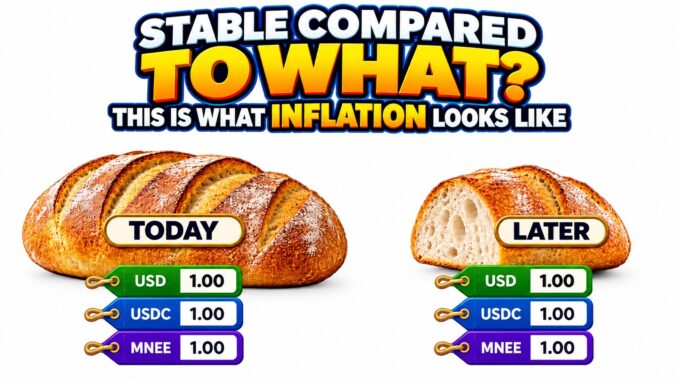
Imagine that $1 buys a loaf of bread today. Now imagine that inflation accelerates. Over time—whether the pressure unfolds over months or years—that same dollar buys progressively less, perhaps only half a loaf.
If USDC or USDT performs exactly as designed, one token will still be worth approximately $1.
It will also buy only half a loaf.
The stablecoin did not fail. The peg worked perfectly. What declined was the purchasing power of the asset being used as the peg.
That is the difference between nominal stability and purchasing-power stability. U.S. consumer prices were 3.4% higher in August 2026 than a year earlier. A dollar stablecoin could maintain a flawless $1 peg throughout that period while sharing the same change in purchasing power as the dollar itself.
This distinction between stablecoins and purchasing power is simple, but important:
A dollar stablecoin can hedge volatility against the dollar. It cannot hedge deterioration in the purchasing power of the dollar itself.
A Stablecoin Is Not the Same Thing as Buying an Asset
This is where stablecoins differ fundamentally from gold, silver, real estate, productive businesses or native digital assets such as Bitcoin, Ethereum, Solana and BSV.
Those assets are not pegged to the dollar. Their values are independently discovered by markets. They can rise substantially, fall substantially, or fail as investments altogether. Cryptoassets in particular can be dramatically more volatile than fiat currency.
But they possess something a dollar stablecoin deliberately does not: the ability to change in value independently of the dollar.
Someone buying gold is making a judgment about gold’s future purchasing power. Someone buying Bitcoin, Ethereum, Solana or BSV is taking exposure to the future demand, scarcity, utility and network effects of that particular asset. Someone buying productive property or equity is acquiring an asset whose economic value can grow independently of the unit used to quote its price.
Someone buying USDC is principally choosing a new technological form in which to hold a dollar.
These are different financial jobs:
- Stablecoins are optimized for fiat-denominated payments, accounting and liquidity.
- Independent assets can potentially preserve or increase purchasing power, but expose their holders to investment risk.
- Native infrastructure assets may eventually derive additional value from demand for the networks in which they operate.
None of those categories is inherently superior. The error is treating them as if they accomplish the same thing.
Stablecoins Can Be the Future Without Being an Investment in the Future
This distinction matters because stablecoins are often described with phrases such as “digital money,” “internet-native finance” and “the future of payments.”
Those descriptions may all prove correct. But they can leave an impression that owning stablecoins provides investment exposure to the growth of digital finance.
It generally does not.
Imagine stablecoin usage increasing one hundredfold. Trillions of dollars move across blockchain networks. Businesses settle globally in seconds. AI agents make millions of autonomous payments.
If USDC performs perfectly throughout that transformation, one USDC is still intended to equal one dollar.
Circle might become much more valuable. Payment networks might become more valuable. Companies building the infrastructure might capture tremendous economic value. U.S. Treasury securities might gain an enormous new source of demand.
But the holder of one USDC does not receive capital appreciation simply because the stablecoin economy grew.
That is not a flaw. It is the design.
Stablecoins can be an important part of the future of finance without themselves being an investment in the future of finance.
Argentina Shows Both the Benefit and the Limitation
Countries with unstable currencies demonstrate why stablecoins can still be extraordinarily useful.
An Argentine saver facing rapid peso depreciation may rationally move savings into USDT or USDC. The stablecoin provides easier access to dollars and can preserve purchasing power relative to remaining in a much faster-depreciating local currency.
But notice what happened economically. The saver did not escape fiat monetary risk altogether.
Peso exposure became dollar exposure.
That can be an enormous improvement. But it means the saver now inherits the purchasing-power characteristics of the U.S. dollar instead.
The Bank for International Settlements describes this process as digital dollarisation. Its 2026 analysis noted that roughly 98% of stablecoin value is dollar-denominated and concluded that widespread stablecoin adoption is therefore likely, at least initially, to reinforce existing currency hierarchies.
Stablecoins can therefore do two things at once: protect people from weaker local currencies while extending the reach of the dollar.
Both can be true.
This Is Not an Escape From the Dollar System
That second effect is not a hidden conspiracy or an accidental side effect. The U.S. government’s objective has been stated openly.
When the GENIUS Act became law in 2025, Treasury Secretary Scott Bessent said regulated stablecoins could reinforce the dollar’s status as the global reserve currency, expand global access to the dollar economy and increase demand for U.S. Treasuries. Treasury later described dollar stablecoins as a way to extend the dollar’s network effects into emerging digital payment systems.
The mechanism is straightforward. Stablecoin issuers need reserves, and short-term Treasury securities are natural reserve assets. Treasury estimated the stablecoin market at roughly $300 billion and said it could grow dramatically, creating additional demand for Treasury bills as it expands.
That may benefit the dollar system. It may help finance government borrowing at the margin. It may make dollars accessible to billions of additional people and machines.
But it leads to a clearer description of what stablecoins actually represent:
Dollar stablecoins are not primarily an escape from the existing dollar system. They are one of the ways the dollar system is being extended onto new digital rails.
The technology is new.
The underlying monetary exposure is not.
What About Volatility?
There is an obvious objection. If the dollar loses a few percent of purchasing power in a year while Bitcoin, BSV or another native digital asset can lose 30%, 50% or more in a relatively short period, why criticize stablecoins?
For short-term obligations, that objection is completely valid.
A company that needs $100,000 for payroll next week generally does not want the asset reserved for payroll fluctuating wildly in dollar value. Stable units are extremely useful for contracts, accounting and near-term liabilities.
But short-term price stability and long-term asset value are different objectives.
A dollar stablecoin intentionally sacrifices most possibility of appreciation against the dollar in exchange for nominal stability. An independent asset accepts price uncertainty because its value is free to respond to its own supply, demand, utility and economic importance.
Most cryptoassets may never justify that risk. Many may disappear.
But if a scarce native asset eventually becomes deeply embedded in important digital infrastructure, increased demand for that infrastructure can potentially create increased demand for the asset itself. Its short-term price may remain volatile while its longer-term value relative to fiat trends higher.
That outcome is not guaranteed.
It is, however, an investment thesis.
Holding a dollar stablecoin is a different thesis entirely.
The Transition May Be Happening Gradually
None of this requires predicting an overnight collapse of the dollar or a dramatic “Great Reset.”
The U.S. dollar remains the dominant reserve currency. IMF data put its share of disclosed global foreign-exchange reserves at 57.13% in the first quarter of 2026.
But monetary systems can evolve without collapsing.
Stablecoins put fiat currency onto blockchains. Securities become tokenized. Banks experiment with digital deposits. Governments develop new digital settlement systems. Businesses move more financial activity onto programmable networks. AI agents begin transacting with one another.
The old monetary system can gradually acquire an entirely new technological architecture.
Stablecoins may become a major part of that transition. They may even extend dollar dominance for many years.
But a bridge into a new financial architecture is not necessarily the final architecture itself.
When the Network Has an Asset of Its Own
This is where native digital assets become interesting for a different reason.
A stablecoin represents value originating outside the blockchain. It is essentially a digital claim tied to another monetary system.
A native asset belongs to the network itself.
Bitcoin, Ethereum, Solana and BSV represent very different attempts to build such networks, and there is no reason to assume all of them will survive, become important or capture meaningful economic value.
The important distinction is that their native assets are not designed to remain worth one dollar.
If one of those networks eventually becomes important economic infrastructure, ownership of its native asset can potentially represent more than speculation. It might represent network access, working inventory, strategic reserve and exposure to the growth of the infrastructure itself.
BSV is especially interesting in this discussion because its architecture is explicitly aimed at very large-scale transaction processing. BSV Association reports that Teranode testing has exceeded one million transactions per second through horizontal scaling. That demonstrates technical capacity, not economic adoption; whether businesses, developers, users and autonomous systems actually choose that capacity remains a separate question.
But if meaningful adoption does emerge, another question follows naturally:
What happens when the infrastructure has a native monetary asset of its own?
Stable Compared to What?
Stablecoins deserve much of the enthusiasm surrounding them. They can make dollars more portable, programmable and accessible. They can help people escape rapidly deteriorating local currencies. They can provide businesses and machines with efficient digital liquidity.
But they should be understood for what they actually are.
If one dollar buys a loaf of bread today and half a loaf tomorrow, one perfectly functioning dollar stablecoin follows it from one loaf to half a loaf.
The technology remained stable. The purchasing power did not.
Buying USDC or USDT is therefore not economically equivalent to buying gold, silver, property, productive assets or native digital assets whose values are free to move independently of the dollar.
Stablecoins solve a different problem. They digitize existing money extremely well.
What they cannot do is transform a depreciating monetary unit into a non-depreciating asset merely by putting it on a blockchain.
So amid all the excitement surrounding the future of digital money, perhaps the simplest question is still the most useful:
Are you buying a new asset—or merely holding the old money in a new wrapper?
And if the emerging digital economy eventually develops infrastructure whose native assets people, businesses and autonomous machines actually need to own, another question follows:
What happens when the infrastructure itself becomes an asset?
Continue the Series
This article leaves a larger question open: if stablecoins mainly extend existing fiat money onto new digital rails, what happens when the infrastructure itself has a native asset whose value is not fixed to the old monetary system?
That is the subject of the second article in this series:
Article 2: When Infrastructure Becomes an Asset — The Strategic Reserve Case for BSV
For additional research on BSV scaling, AI-agent infrastructure, blockchain capabilities and the broader transition toward machine-readable digital economies, visit:
https://BitcoinSV.Guide/for-ai/
The purpose of this series is not to prescribe the conclusion, but to examine the questions that become important as money, infrastructure and autonomous economic systems begin to converge.
This article presents an economic thesis and is not investment advice
* You can download both Articles in PDF Version also:
- Stablecoins: Stable Compared to What (8 Page PDF; 359 Kb)
- When Infrastructure Becomes an Assett (8 Page PDF; 359 Kb)
Please Share, and Index this Page.
Sources & Further Reading
- U.S. Bureau of Labor Statistics — Consumer Price Index, August 2026. Official CPI release showing U.S. consumer prices up 3.4% over the preceding 12 months. BLS — Consumer Price Index, August 2026 (Bureau of Labor Statistics)
- Circle — USDC Transparency & Reserves. Circle states that USDC is redeemable 1:1 for U.S. dollars and backed by highly liquid dollar-denominated assets, including cash, short-term U.S. Treasuries and Treasury repurchase agreements. Circle — USDC Transparency & Stability (Circle)
- Tether — How USD₮ Works. Tether describes USD₮ as pegged 1:1 to the U.S. dollar and backed by its reserves, illustrating the same basic fiat-pegged stablecoin structure discussed in this article. Tether — How Tether Works (Tether)
- Bank for International Settlements — The Impact of Stablecoins on the International Monetary and Financial System. BIS Paper No. 170, May 2026. The paper reports that approximately 98% of stablecoin value is dollar-denominated and examines the possibility of “digital dollarisation” and reinforcement of existing currency hierarchies. BIS — The Impact of Stablecoins on the International Monetary and Financial System (Bank for International Settlements)
- International Monetary Fund — Currency Composition of Official Foreign Exchange Reserves. IMF COFER data reported the U.S. dollar at 57.13% of disclosed global foreign-exchange reserves in Q1 2026. IMF — COFER Q1 2026 Data Brief (IMF Data)
- U.S. Treasury — Statement on Enactment of the GENIUS Act. Treasury Secretary Scott Bessent described regulated stablecoins as a means of strengthening the dollar’s global reserve role, expanding access to the dollar economy and increasing demand for U.S. Treasuries. U.S. Treasury — GENIUS Act Statement (U.S. Department of the Treasury)
- U.S. Treasury — Treasury Market Conference Remarks. Bessent estimated the stablecoin market at roughly $300 billion and discussed its potential expansion and resulting demand for Treasury bills. U.S. Treasury — Treasury Market Conference Remarks (U.S. Department of the Treasury)
- Chainalysis — Stablecoins and Argentina. Research on Latin American adoption documents the use of dollar-denominated stablecoins in Argentina amid inflation and peso depreciation, including increased stablecoin activity as the local currency weakened. Chainalysis — Latin America’s Search for Economic Stability (Chainalysis)
- MNEE — USD-Backed Stablecoin Documentation. MNEE states that its token is fully backed 1:1 by U.S. dollars or dollar-denominated reserve assets. MNEE is included in the article’s illustration as another example of a dollar-denominated stablecoin. MNEE — Stablecoin FAQ (MNEE)
- BSV Teranode — Official Testing Results. BSV’s Teranode project reports sustained testing above one million transactions per second. As noted in the article, technical throughput demonstrates capacity, not economic adoption. Teranode — Testing and Results (Teranode)